Davide Soliani Davide Soliani

What's Shenmue

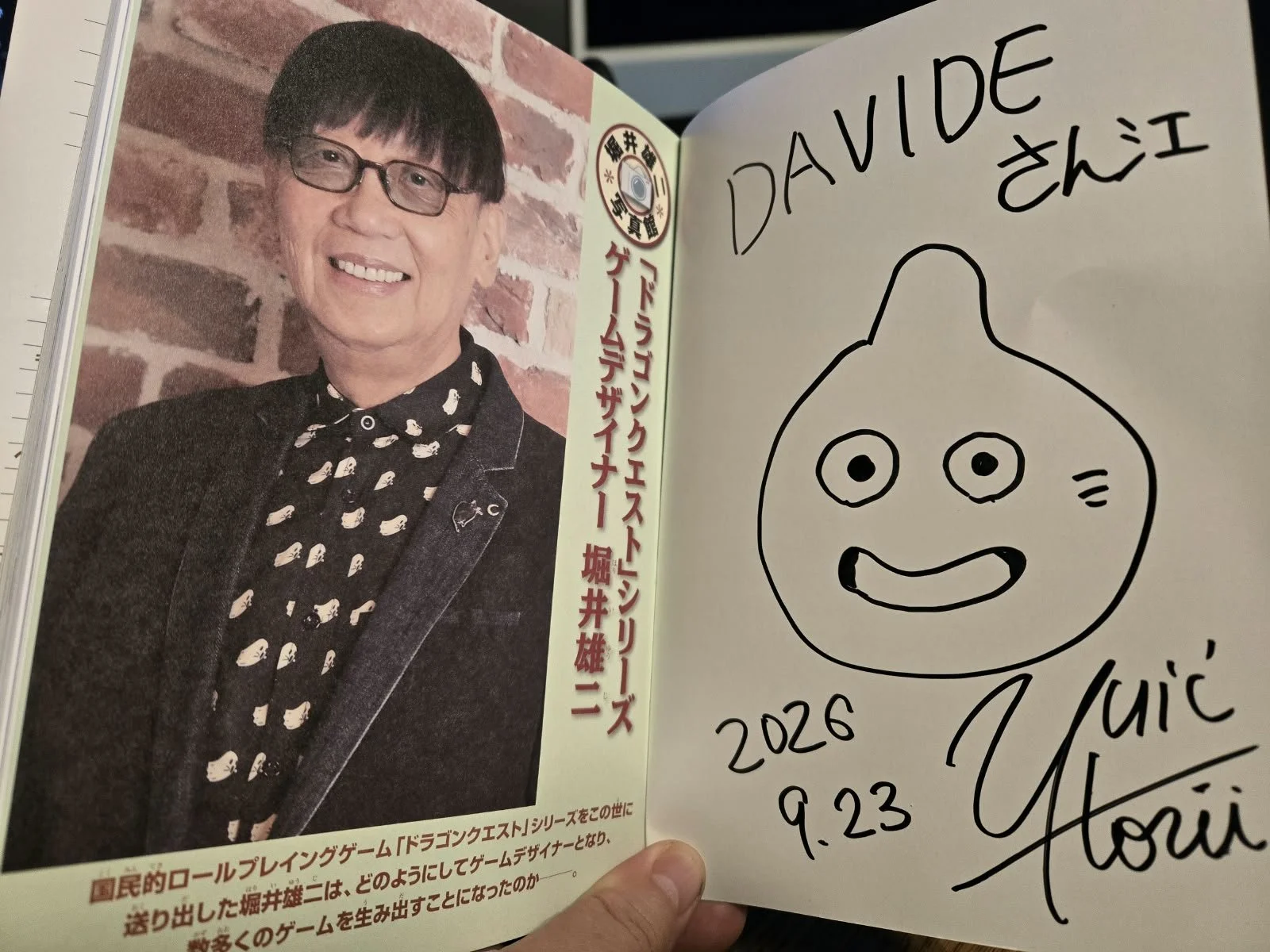
Shenmue hit me like a bolt from the blue. It was unbelievable for the time — a game that pushed far beyond the boundaries of anything I was used to…

It was December 29, 1999 when Joystick Fun managed to get me an imported copy of Shenmue. And Shenmue hit me like a bolt from the blue. It was unbelievable for the time — a game that pushed far beyond the boundaries of anything I was used to. I remember two precise moments that made me realize this magic wasn’t affecting just me, but other people as well (and anyone who denies it is lying).

Back then I used to play every noteworthy release with a close friend of mine. We’d meet at my place with chips and Coca-Cola and spend entire weekends playing, carefree. When we started playing Shenmue, we were wide-eyed the entire time. It was more than we could even process: “How does time pass like this?”l, “Wait, we can go anywhere?”, “There’s day and night?”, “Hey look, gacha machines!”, “Hey, a kitten.”, “Wait… is it raining now?”

There was simply no escaping the charm of that game. Impossible. At some point, about six hours in, I ran out of cigarettes (I was still smoking back then, fortunately I later decided to quit). I looked at my friend and said, “Let’s go get cigarettes at the tobacco shop.”He looked at the screen and replied, “Okay, tell me which way it is — I didn’t see where it was.”

I looked at him, confused, and said, “No, I mean in real life. Let’s step outside for a minute — I need to buy cigarettes.”

That moment made me think a lot. Something as mundane as going to buy something in the real world had suddenly become a plausible action inside a video game. Today it might sound trivial, but in 1999 it absolutely wasn’t.

The second moment happened at Ubisoft. I had brought in the Shenmue demo — called What’s Shenmue that let you inspect the characters up close. You could zoom in on these polygonal models and see their textures and details, completely out of proportion with what we were used to at the time (remember: this was 1999).

I loaded Shenhua, and there were about ten people gathered around me. I zoomed in on her eyes, and one of the programmers jokingly said, “Look, you can even see our reflection.”

Everyone leaned forward to check if they could see themselves reflected in Shenhua’s eyes.

Of course that wasn’t possible — it would have been insane to think otherwise. But the magic was so strong, and the technology felt so alien, that for a few seconds it actually seemed plausible to a small group of mesmerized developers.

Anyway, recently I decided to replay both Shenmue I and Shenmue II. Back then I actually played Shenmue II on a Microsoft console, which meant I couldn’t carry over my save file from the first game.

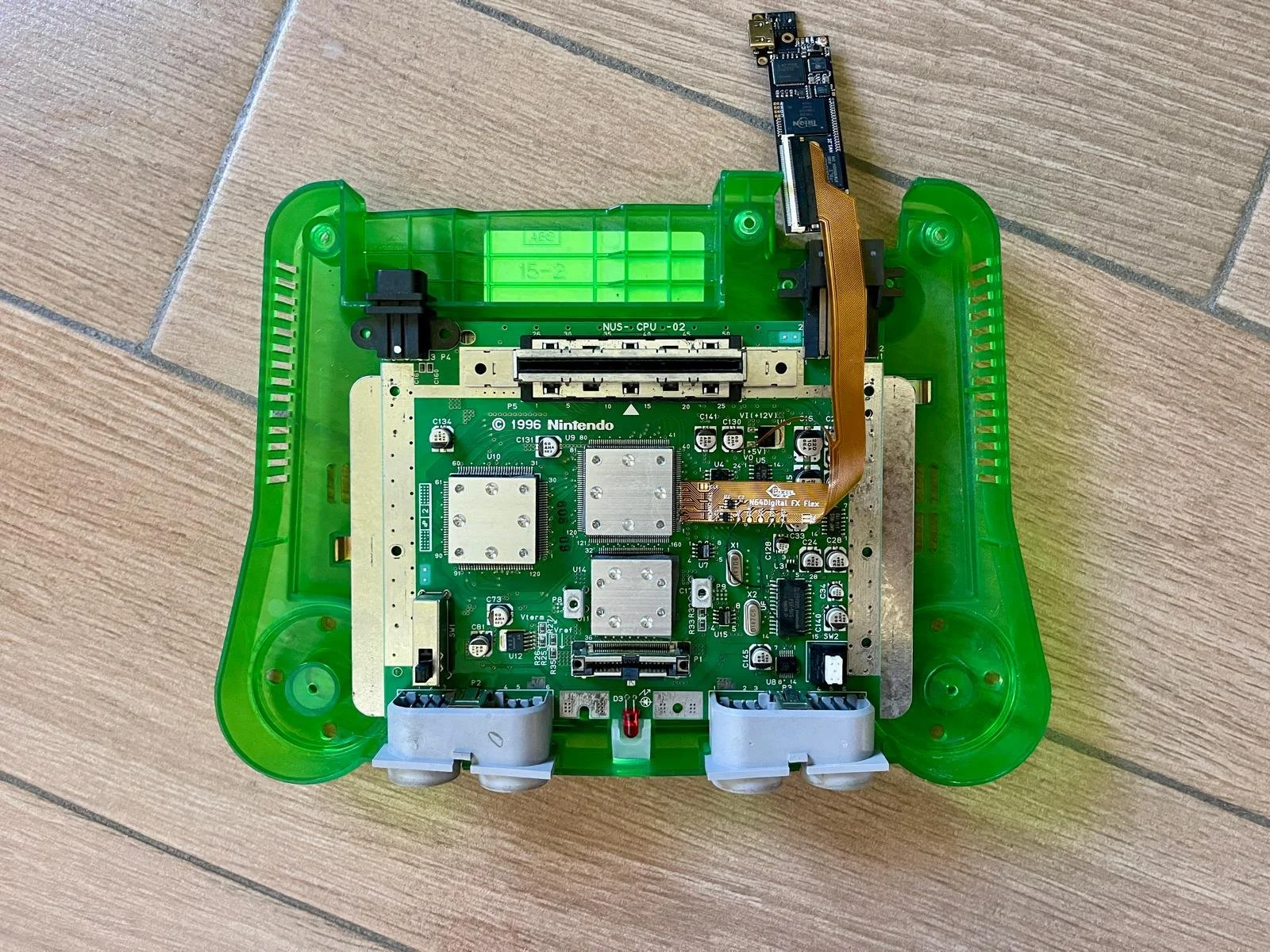
That’s where a friend of mine, Alessandro, comes in. He helped me bring my old, battered Dreamcast back to life. He replaced the capacitors, installed a silent 3D-printed fan, added a chip to remove the region lock, replaced the drive motor, and even swapped the motherboard, which had become very unreliable Installed the reader motor with the metal gear, the removable battery holder, and a 220-volt power supply so I don’t need to use a converter.

In short, he restored it like new.
So I prepared accordingly. I bought a brand-new Dreamcast controller, still sealed. I bought a brand-new copy of What’s Shenmue, never opened. I connected the Dreamcast through VGA to my RetroTINK 4K, dimmed the lights, and it was like magic — I was transported back to 1999.

I replayed all of Shenmue with the fireplace burning and snow falling outside. I revisited every corner of the game, every conversation, feeling emotional at every turn.

Now, with the proper save file ready, I’m preparing to face Shenmue II again.

God, how I wish Yu Suzuki could finish this saga. Governments should give him the money to do it — not letting him finish it feels like a crime against humanity. Now I truly want to play Shenmue II again. But I’m afraid. I’m afraid that once I finish it, I’ll have to move on to Shenmue III on a non-Sega console… and then nothing.

I truly hope the future still has a new chapter of the Shenmue saga waiting for us. I see I’m not the only one hoping that Shenmue will one day return and finally complete its saga. There’s a channel I regularly follow run by passionate Shenmue fans called Shenmue Dojo—I’ll leave the link here.

Just like me, they’re still hoping for the saga to make a comeback. Following them is always a pleasure, and I fully share their passion and enthusiasm.

Honestly, with the incredible engine used by the team behind the Yakuza games, I sometimes wonder why Sega hasn’t decided to make it happen yet.

Scopri di più
Bass Davide Soliani Bass Davide Soliani

Californication Bass Cover

It was a lot of fun learning this piece…

It was a lot of fun learning this piece. I know it’s probably very easy for people who really play, but it took me a while. There are a few small mistakes here and there, but it’s all live — no tricks, no cheating. I really should sit down and properly learn how Scarlet Solo works. I’ll try to find the time. Apologies to the real bass players who might stumble upon this video. I’m doing this mostly for myself, to keep track of my progress more than anything else. Much love.

By the way, if you fancy my bass, it is a Biarnel bass guitar, made by a Luthier in Firenze, Italy. You can find his website here

Scopri di più
Bass Davide Soliani Bass Davide Soliani

Dark Necessities Bass Cover

I'm butchering it, sorry Flea and sorry real bassists out there. At least, pushing it for the last two months made me able to play it. Its far from perfect, there's are indecisions and imprecisions along the way, but still a small milestone for me :D

That's it, this was the hardest track I have tried to do with the bass, far beyond my skills. I've tried anyway. When I started learning this piece, I tought it was absolutely impossible. I told myself "I'll do it in another life". At the end, by breaking it apart and learning and training on smaller slices of it, day after day, I've been able to record it. I'm butchering it, sorry Flea and sorry real bassists out there. At least, on my side, pushing it for the last two months made me able to play it. Its far from perfect, there's are indecisions and imprecisions along the way, but still a small milestone for me :D

Now I’m going to learn Sir Duke and I’ll see if Grant Kirkhope want to play it along with me

Scopri di più
Dev Diaries Davide Soliani Dev Diaries Davide Soliani

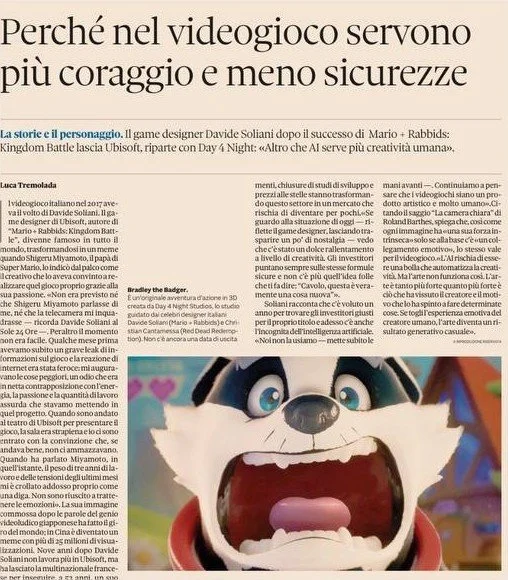
Bradley The Badger

On December 11th, 2025, we had the incredible fortune of premiering our first trailer at The Game Awards, thanks to Geoff Keighley. From that moment on, a lot changed. The trailer was a great success. I will never stop being amazed at how much a developer’s life can change when players show their support. It’s truly powerful — in every sense.

As many of those who know me already know, I left Ubisoft a year and a half ago. Cristina Nava, Gianmarco Zanna, Luca Breda and I decided to try to build something of our own.

It was almost by accident — half joking, really — that while talking with Christian Cantamessa we started discussing a game idea. At first it was supposed to be something very small, made with very few people and even less money. But the more we worked on it, the more we believed in it. It slowly became something much bigger than we had ever planned.

Bradley The Badger was born almost on its own. The ideas kept pouring out, one after another — and they still do. The only difference is that now we pretend not to hear them, otherwise we’d never actually finish this game.

On December 11th, 2025, we had the incredible fortune of premiering our first trailer at The Game Awards, thanks to Geoff Keighley. From that moment on, a lot changed. The trailer was a great success. I will never stop being amazed at how much a developer’s life can change when players show their support. It’s truly powerful — in every sense.

I had been meaning for a while to publish the trailer on my website, which by now is pretty much the only social platform I use. In doing so, I want to sincerely thank everyone who has supported us — and who continues to support us.


An endless thank you to everyone who added the game to their wishlist on Steam. And thank you as well to those who just passed by but shared a smile with us after watching the trailer.

Scopri di più
Davide Soliani Davide Soliani

Maddalena

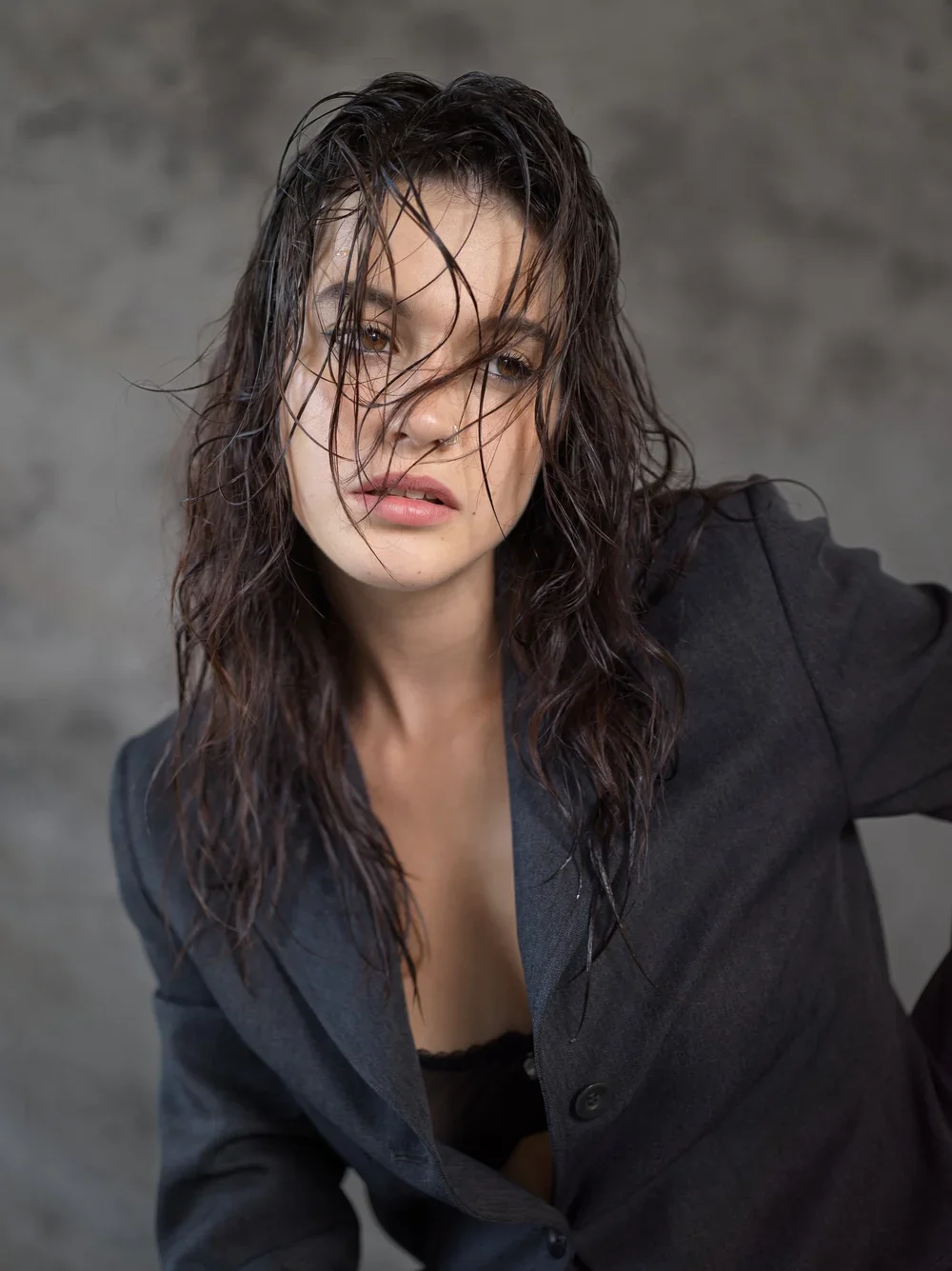
Have you ever done a photoshoot with models who yawn out of boredom because they’d rather be somewhere else? Well, this was the exact opposite…

Yesterday I went to Filanda Pregiata for a two-hour photo session with Maddalena, a 25-year-old model based in Milan who, as I found out, occasionally rents the rooms at Filanda Pregiata herself.

Maddalena is very young, but her posing experience, refined photographic taste, and ability to read the light are undeniable strengths. On top of that, she’s an absolute pleasure to work with—sunny, professional, and genuinely hardworking.

Have you ever done a photoshoot with models who yawn out of boredom because they’d rather be somewhere else? Well, this was the exact opposite. Maddalena truly cares about her work. She’s curious to review the shots as we go and uses them to refine her poses and suggest new ideas. Personally, I had a great experience working with her and I can’t wait for her to be back around here.

If you are interested to work with her, you can find it on Instagram here.

Scopri di più
Davide Soliani Davide Soliani

Alice

La Filanda has become my go-to place for photography. Not only does it offer many different spaces to explore—each with its own character and expressive potential—but there’s also a very important factor: the economic impact on the wallets of amateur photographers like me. I do photography purely for fun. I don’t make money from it—if anything, I only spend money…

La Filanda has become my go-to place for photography. Not only does it offer many different spaces to explore—each with its own character and expressive potential—but there’s also a very important factor: the economic impact on the wallets of amateur photographers like me. I do photography purely for fun. I don’t make money from it—if anything, I only spend money.

La Filanda offers a price list that is truly unmatched compared to what you can find in bigger cities, Milan first and foremost. And the spaces are absolutely on the same level—if not better, in most cases—than those in more famous locations. If that’s not clear enough, I strongly recommend you book two or three hours (you can even mix different rooms) and then come back and tell me if you had fun or not. Oh, I almost forgot: the smoke machine (there are two, in different sizes) is included in the price. (I’ll leave you with two quick clips from one of the rooms at the bottom of the post).

Anyway, I went back, and instead of renting the big room, this time I chose one of the smaller ones, called “Il Filandino.” Inside, there’s a bookshelf, tables with chairs, a glass door that is photographically super interesting, a bar counter with glasses and liquor bottles, and a thousand little props—radios, a rustic kitchen, pans, trophies, and all kinds of random objects.

With Alice, the model who spent the morning posing for me—and whom I can’t stop recommending—we used every single square centimeter available. As usual, beyond the fact that Il Filandino is already an interesting space full of interesting furniture, you end up taking photos of plain walls too, just because the sunlight, in that space and at a certain hour, comes in at an angle in such a special way that you decide to dedicate a few poses to it.

In any case, I hope the photos will interest you. Soon I’ll try to organize a day where I’ll photograph several friends. Lately I’ve been really in the mood for male portraits. See you next time.

If you are interested, here’s the Filanda Pregiata address

Filanda Pregiata Facebook Page

Scopri di più
Portraits Davide Soliani Portraits Davide Soliani

Roberto Villa

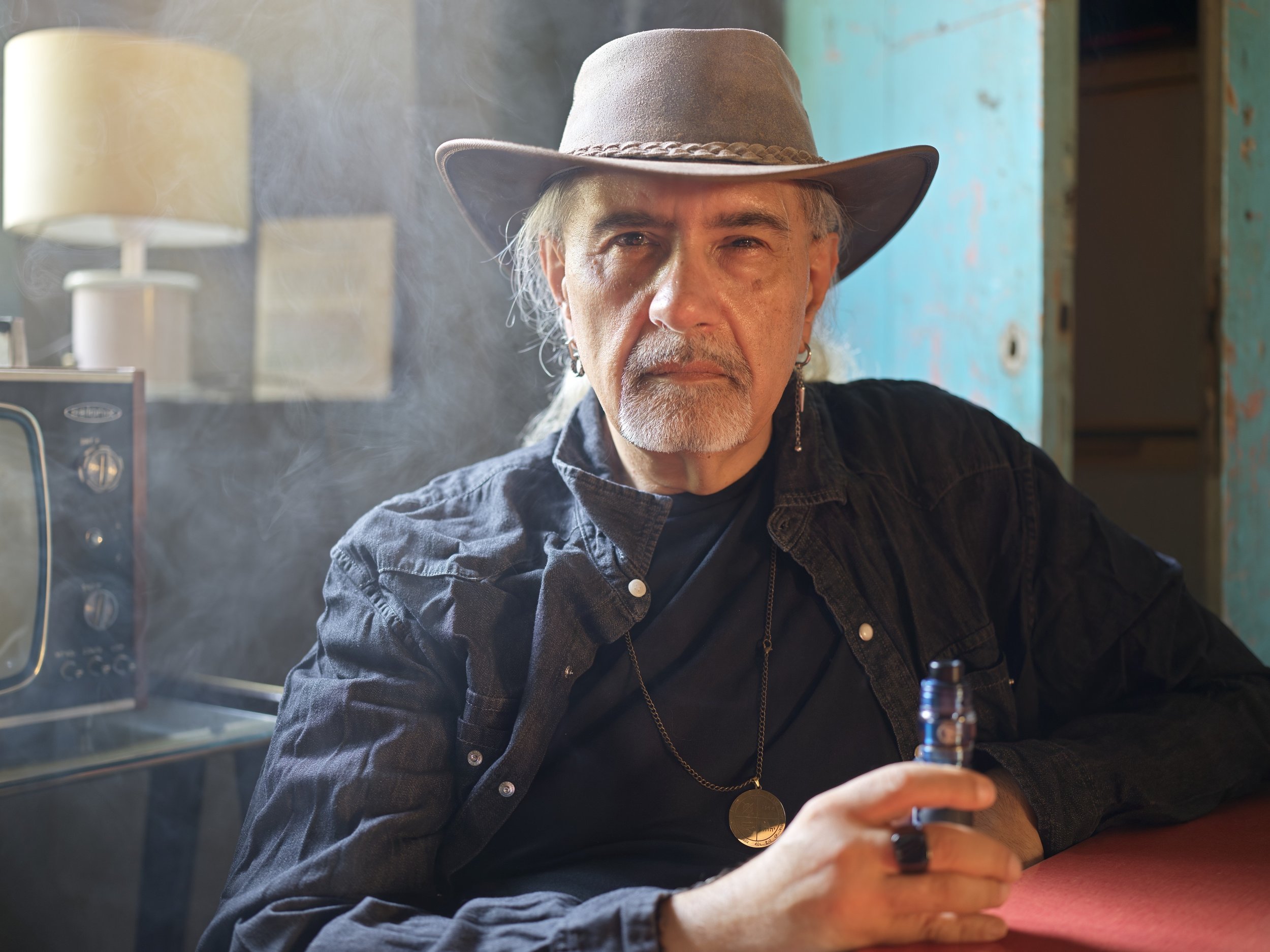
Roberto Villa, known to everyone simply as “Master,” is a Milan-based psychotherapist and the author of the science-fiction novels Le Cronache di Ishtar (2018, Illiterate Move) and Samsara Gambit (2024, Illiterate Move), as well as the narrative role-playing game Saga (2017, Illiterate Move) and its expansion Saga Svelata (2019, Illiterate Move). But titles and publications only tell part of the story…

Roberto Villa, known to everyone simply as “Master,” is a Milan-based psychotherapist and the author of the science-fiction novels Le Cronache di Ishtar (2018, Illiterate Move) and Samsara Gambit (2024, Illiterate Move), as well as the narrative role-playing game Saga (2017, Illiterate Move) and its expansion Saga Svelata (2019, Illiterate Move). But titles and publications only tell part of the story.

He is, without exaggeration, the greatest role-playing game master I have ever met.

If I had never known him, I would never have played Pendragon. And if I had never played Pendragon, I would never have become the designer I am today. Through his way of running games—patient, rigorous, imaginative, and deeply human—he taught me what role-playing could truly be: not escapism, but a form of shared authorship, responsibility, and emotional truth.

I owe him more than I can ever repay. That debt can never really be settled—but that doesn’t mean I won’t spend a lifetime trying.

Roberto and I spent a morning shooting at Filanda Pregiata, having fun experimenting with different poses and moods. Even though Roberto isn’t a professional model, he was absolutely fantastic in front of the camera—naturally expressive, comfortable, and surprisingly powerful both in his body language and in his facial expressions.

I enjoyed the session so much that I’m certain we’ll plan another one in the future, this time in a more deliberately staged environment. I can easily imagine something with a gothic atmosphere, inspired by Edgar Allan Poe or H. P. Lovecraft, which feels perfectly suited to the aura of mysticism that seems to surround Roberto so effortlessly.

Scopri di più
Davide Soliani Davide Soliani

Filanda Pregiata

Lately, I’ve discovered a very interesting place not too far from where I live: Filanda Pregiata, in Soresina.

The history of Filanda Pregiata is an example of urban and artistic redevelopment. Once an industrial facility—probably dating back to the 19th century and connected to textile production, as the name suggests—it has been transformed into a crossroads of creativity.

Lately, I’ve discovered a very interesting place not too far from where I live: Filanda Pregiata, in Soresina.

The history of Filanda Pregiata is a great example of urban and artistic regeneration. Once an industrial complex—likely dating back to the 19th century and tied to textile production, as the name suggests—it has been transformed into a vibrant creative hub. Artists such as Riccardo Bonfadini (a painter and the first to settle there), Lucio Arzuffi (a gallerist), and Paolo Mezzadri (a sculptor) established their studios in the space, opening it up to events and art exhibitions. Today, Filanda Pregiata is a multifunctional venue that also hosts photo shoots and production sets, while preserving the strong industrial and historical character of the site.

Alice and Beatrice - B/W 55mm Hasselblad

There are essentially three studio spaces, all of them extremely compelling and available not only for photography, but also for other types of events.

The smallest studio is called Il Filandino. Inside, there’s a bar counter, a beautifully aged country-style kitchen, and a cozy sitting area with an armchair and a sofa. The walls are richly decorated with vintage radios, paintings, and various eclectic objects. Even though the space isn’t very large, every corner of Il Filandino offers creative potential and is visually engaging.

The second, medium-sized space has a distinctly industrial feel. The walls are more minimal, with the classic columns typical of large industrial buildings and big, bright windows flooding the room with natural light. This space often functions as an art gallery, so it’s not uncommon to find interesting paintings on display. There’s a massive wooden table, a swing, and countless photographic setups packed with opportunities.

The final space is the largest one—the main filanda—where workers and sewing machines once filled the floor. It’s a huge rectangular hall, roughly 40–50 meters long and about 12 meters wide, bordered by enormous windows on three sides. The ceiling is very high, probably around 8 meters, and the bare structure itself is striking in its raw, unfiltered state. That said, the space is anything but empty: it’s filled with an incredible assortment of props and objects, from antique basins to sofas and lounge furniture, bookcases, tables, vintage radios, naval spotlights, and much more.

The prices are absolutely fair, nothing like Milan, and no, this isn’t some run-down place — we’re talking about very large spaces, pre-furnished and easy to customize. Basically, a real playground. A small paradise for anyone who loves photography without necessarily being a professional, but it’s also a place professionals use.

I did a photo session there and had a great time during a workshop led by Luca Alutto, a professional photographer I met recently and immediately clicked with — both professionally (he really knows his craft) and on a human level. I’m leaving his Facebook page here in case you’re interested in taking a workshop with him.

The shoot was coordinated by Luca and featured two models I found extremely professional and genuinely nice (highly recommended). They pose beautifully, with no attitude and no drama to manage. They really know how to make you feel comfortable, especially if you’re a quiet, shy type like me.

Below you’ll find the Instagram profiles of Alice and Beatrice.

Alice

Beatrice

Scopri di più
TheLostArchive Davide Soliani TheLostArchive Davide Soliani

The Forgotten Palace of the Gonzagas

In the decades that followed, time and humidity reclaimed the walls. The plaster peeled away, the floors sank, ivy crept through the windows…

Long before the Gonzaga family ruled Mantua, the lands around Portiolo, deep in the Po Valley of northern Italy, belonged to Matilda of Canossa. Around the year 1100, she donated much of the area to the monks of San Benedetto in Polirone, one of the most influential abbeys of medieval Europe.

The flat, fertile landscape — full of water, game, and silence — would later become the perfect backdrop for noble retreats and hunting estates.

During the 15th and 16th centuries, as the Gonzagas rose to power, they transformed these lands with villas and rural palaces. Among them stood the Corte di Portiolo, which would later be known as Palazzo Gonzaga di Vescovato — a blend of fortress, farm, and noble residence.

The Golden Age

Originally built as a fortified rural court, the villa evolved over time into a noble country residence. The Gonzagas used it for hunting trips, countryside gatherings, and quiet escapes from Mantua’s court life.

Historical accounts describe geometric gardens, elegant arcades, and frescoed halls, where noble guests enjoyed the pleasures of the Renaissance. Architecturally, it mirrored the refined simplicity of the Lombard plain: a large central building flanked by symmetrical wings and inner courtyards.

By the 17th and 18th centuries, the estate had passed to a minor branch of the Gonzaga family. The splendor of Mantua was fading, and with wars, debts, and political decline, so too faded the fortune of this once vibrant retreat. Yet the building endured.

Decline in the 19th Century

During the 1800s, the palace gradually lost its noble function. Parts of it were converted into barns, granaries, or housing for farm workers. Still, much of the structure remained intact: wooden ceilings, ornate staircases, and faded frescoes.

After World War II, the estate was still inhabited by local families. The last resident, according to local lore, was an elderly woman who refused to leave her home. She lived there alone until the 1960s, when the palace finally fell silent. I’m honestly not super sure of this information. Other clues, suggest that there still was a family living here until an eartquake occured in 2012, in all the Mantua’s area.

Abandonment and Legend

In the decades that followed, time and humidity reclaimed the walls. The plaster peeled away, the floors sank, ivy crept through the windows.

By the early 2000s (maybe 2012, after the family left), the site had become a pilgrimage spot for urban explorers — photographers and adventurers drawn to its haunting beauty. Online, it earned a kind of cult status.

The Present

In recent years, authorities have secured and partially restored some areas to prevent further collapse. Access is now restricted, but the building remains one of the most fascinating Gonzaga residences precisely because of its authenticity — half ruin, half relic of lost grandeur.

A Symbol of the Mantuan Plain

Today, those who approach the site can still see the weathered façade, the shuttered windows, and the archways choked by vines, imagining the carriages that once crossed its courtyard.Palazzo Gonzaga di Vescovato stands as a quiet monument to the rise and fall of Renaissance nobility.

Scopri di più
Stories Davide Soliani Stories Davide Soliani

The Creature from Cusago

They say that in the summer of 1792, something unspeakable stirred in the woods around Cusago, a quiet town just beyond Milan. Locals began to whisper of a creature that came out only at night — La Bestia di Cusago, The Beast of Cusago. What followed was not rumor, but record…

They say that in the summer of 1792, something unspeakable stirred in the woods around Cusago, a quiet town just beyond Milan. Locals began to whisper of a creature that came out only at night — La Bestia di Cusago, The Beast of Cusago.

What followed was not rumor, but record. In early July, a ten-year-old boy named Giuseppe Antonio Gaudenzio vanished while looking for a stray cow near the forest. The next morning, they found him — what was left of him — half-devoured, his clothes soaked in blood. Within days, panic had spread through the countryside. In Limbiate, children guarding cattle were attacked; those who climbed trees watched helplessly as the creature dragged away eight-year-old Carlo Oca. Then came Giuseppina Saracchi, ambushed on a country road while walking with her sister. Three children, gone — and fear now had a name.

Descriptions of the Beast varied, but all were terrifying. Some swore it had the head of a boar and the body of a dog, as large as a bull, its back streaked with reddish hair. Others spoke of horse-like ears, thin limbs ending in clawed paws, a tail long and curled. Hunters claimed their rifles jammed when they aimed, and that even the bravest among them trembled, unable to pull the trigger. The creature seemed untouchable — almost unnatural.

Desperate, the authorities offered fifty zecchini — a small fortune — to anyone who could bring it down. Pits were dug, bait animals tied to stakes, and armed men filled the fields. By late September, they declared victory: a wolf had fallen into a trap near Cascina Pobbia. Its carcass was displayed, then sent to the Natural History Museum in Pavia as proof that the terror was over.

But those who had seen the real Beast never believed it. What they remembered was something far larger, far stranger than any wolf. And when, years later, the stuffed body vanished from the museum without explanation, the doubts only deepened.

Some historians say it was simply a starving animal, driven mad by hunger. Others compare it to the legendary Beast of Gévaudan — a predator born of fear as much as flesh. Yet for those who still live in the shadow of Cusago’s woods, the legend endures. On cold nights, when the fog drifts low over the fields, they claim to hear a growl in the distance — faint, guttural, unmistakable.

They call it the Devil Wolf, the lupo del diavolo.

And every year, when summer turns to autumn and the nights grow long, the people of Cusago remember the dark season when something walked among them — something that never truly went away.

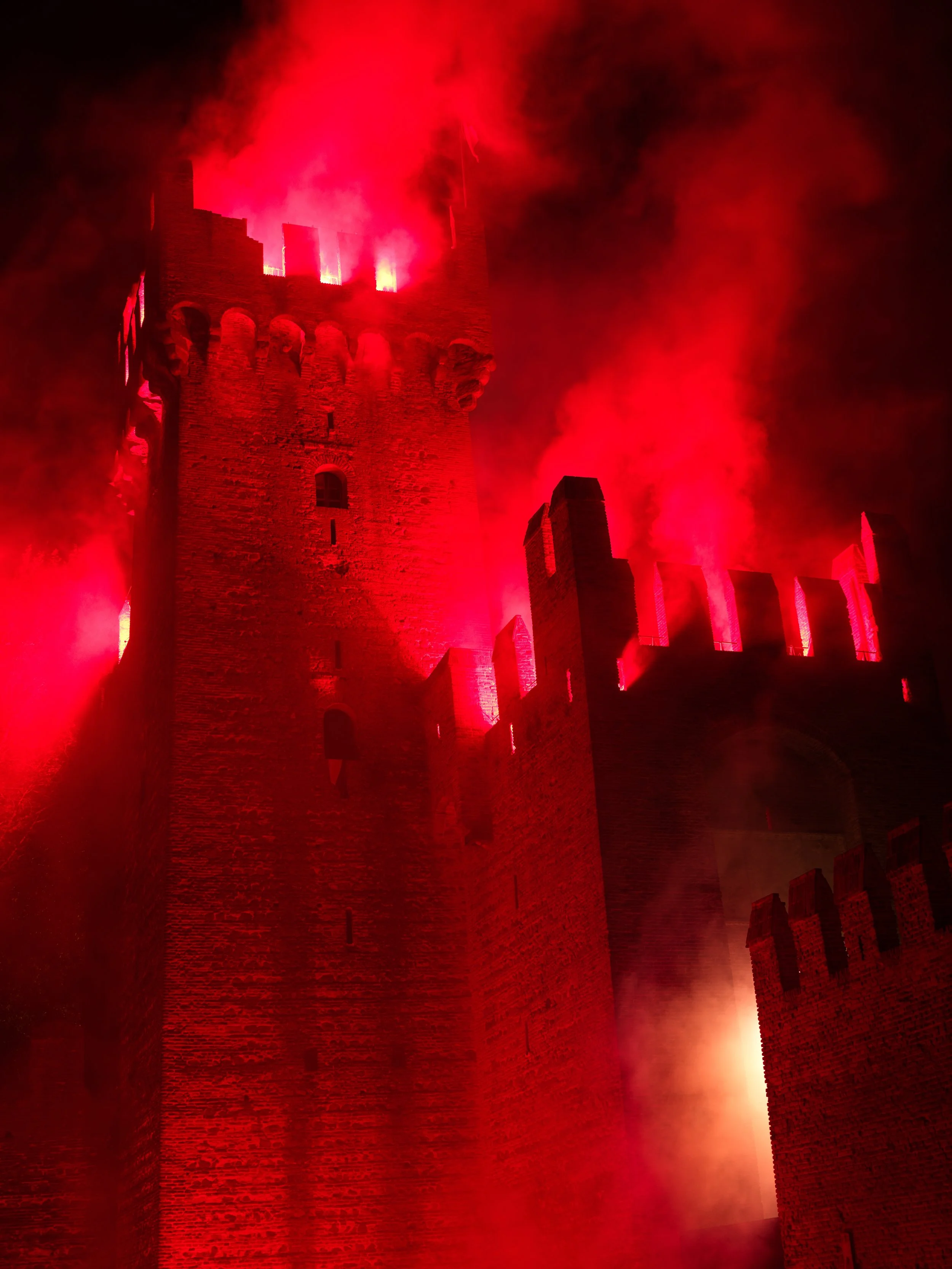
Today, that same forest is sealed off, under the control of the Demanio, officially closed to the public. But a few weeks ago, curiosity got the better of me. I went in anyway. Deep among the trees, we found an abandoned lodge, silent and forgotten, its windows shattered, its roof half-swallowed by vines. The air felt heavy — still, but alive somehow. I wasn’t alone; a friend had come with me. And yet, the whole time, I kept trying to guess where the nearby highway was — just to stay oriented, in case I had to run out quickly, and to make sure I didn’t lose myself in there.

They call it the Devil Wolf, the lupo del diavolo.

And standing there, with the woods pressing in from all sides, I understood why.

Scopri di più
TheLostArchive Davide Soliani TheLostArchive Davide Soliani

The Painted House

I remember feeling dizzy as I left. I remember that, maybe for the first time, I was afraid of the passing of time…

The light — cold and slanted — cuts through the space like in a painting by Hammershøi. On the right, the mannequin stands guard like a forgotten body in a Balthus scene. It has something human about it, yet remains an object — a silent witness. In the back, where the room opens and the warm daylight meets the mess, the metaphysics of de Chirico quietly surfaces.

The villa is enormous. I spend the whole morning photographing it, but that hallway keeps me frozen in place for nearly an hour. Only when the light begins to shift do I finally move to another room.

The rooms are filled with objects. For the first time in years of urban exploration, I feel uneasy — like an intruder stepping into someone’s life uninvited, even though the house is clearly abandoned.

It’s not an ordinary home. There are objects of every kind, and each one feels like it carries its own story. It reminds me a lot of how my father and I decorate our homes — eclectic, creative, sometimes completely illogical. I get the sense that whoever lived here led a rich, passionate life.

I found a letter. It’s written in French. There are no names or references, so I don’t think it’s disrespectful to translate it and include it here, among the photos in this album.

Nîmes, February 12, 1974
My dear friend,
I think I’ve taken a little too long to answer your letter, but I’m following your advice and writing after the noise of the holidays has finally faded. As you know, the “winter blues” hit me hard this year — December and January were rough. I was very tired: a bad cold, a bit of gastritis, and a whole series of minor annoyances… nothing too serious, fortunately. I’m feeling better now.
The tests and doctor visits all came back reassuring, so here I am again, back to work — still confined to bed, yes, but with a calmer mind and a little time on my hands.
Thank you, my dear friend, for your kind wishes, which I return with all my heart. Above all, I wish you good health, for you and your family, and much happiness surrounded by your children and grandchildren. Let’s hope for many more good hours shared together.

I remember feeling dizzy as I left. I remember that, maybe for the first time, I was afraid of the passing of time.

Scopri di più
TheLostArchive Davide Soliani TheLostArchive Davide Soliani

A walk inside a novel

When I visited it, the place hadn’t been vandalized yet. It felt like stepping straight into the pages of Murakami’s Dance Dance Dance, with echoes of Kubrick and King hanging in the air. The whole complex was massive — endless hallways, silent rooms, a strange stillness that made time feel uncertain. But there was only one thing that truly stayed with me: the central hall. That room… I’ll never forget it.

The Grand Hotel et de Milan in Salsomaggiore Terme stands as one of Italy’s most fascinating testaments to the Belle Époque era — a time when luxury, wellness, and art came together under the banner of European elegance.

It was at the turn of the 20th century, when Salsomaggiore Terme was emerging as one of the most fashionable spa destinations in Europe, that the Grand Hotel was conceived. The town’s saline-bromine-iodine waters were celebrated for their healing properties, attracting aristocrats, diplomats, and artists from across the continent. To accommodate this sophisticated clientele, the local elite commissioned a grand hotel that could rival the finest establishments in Paris, London, and Vienna.


Designed by the Milanese architect Luigi Broggi, the hotel opened its doors in 1901 under the name Grand Hôtel des Thermes. It was a marvel of its time — over three hundred rooms, state-of-the-art heating, a vast park, tennis courts, and sumptuous interiors decorated in the Liberty style. Everything about it spoke of modernity and refinement. In the years that followed, the hotel caught the attention of famed hoteliers César Ritz and Alphons Pfyffer, who took over its management and, eventually, ownership around 1910. Under their direction, the Grand Hotel became one of the jewels of European hospitality.

The 1920s brought a new wave of artistic splendor. The architect Ugo Giusti and the celebrated artist Galileo Chini enriched the building with bold Liberty and Moorish-inspired decorations. The Salone Moresco, with its intricate patterns and glowing colors, remains one of the most remarkable examples of early 20th-century interior design in Italy. For decades, the Grand Hotel was the beating heart of Salsomaggiore’s high society — a place where elegance met leisure, and where the international elite came to take the waters, dance, and dine in opulent surroundings.

But like many symbols of the Belle Époque, the hotel’s golden age could not last forever. After World War II, tastes and economies changed. Tourism shifted, and Salsomaggiore’s glamorous clientele began to fade.

When I visited it, the place hadn’t been vandalized yet. It felt like stepping straight into the pages of Murakami’s Dance Dance Dance, with echoes of Kubrick and King hanging in the air. The whole complex was massive — endless hallways, silent rooms, a strange stillness that made time feel uncertain. But there was only one thing that truly stayed with me: the central hall. That room… I’ll never forget it.

Scopri di più
TheLostArchive Davide Soliani TheLostArchive Davide Soliani

Western Village

Western Village, tucked away near Nikkō, was once a full-scale Wild West theme park — a surreal slice of America deep in Japan. It opened in 1975, when Enichi Ominami decided to turn his family ranch into a living, breathing frontier town.

During my first trips to Japan, I stumbled upon an abandoned place that instantly reminded me of Westworld (1973) — the original one, with Yul Brynner as the villain. And what a villain he was — an unstoppable machine, like the T-800 or the T-1000, but eleven years earlier.

My first visit to that abandoned park, filled with robots, shattered plastics, exposed circuits, and a haunting silence, was one of the most intense exploration experiences I’ve ever had. I had such a strong urge to rescue one of those robots and bring it back to life. One of them was the Sheriff. I found him near a caravan — someone had stripped off his clothes, leaving his transparent plastic body exposed, revealing all his inner circuits.

I went back years later, and then again. Each time, it looked worse — thanks to all the Western You Tubers who went there for Halloween, flipping everything upside down, filming goofy skits with the robots, undressing them, breaking them, making them smoke — all kinds of nonsense that could’ve easily been avoided. The last time I went, they had already started dismantling the place, probably to clear and sanitize the area. Such a shame. Western Village, tucked away near Nikkō, was once a full-scale Wild West theme park — a surreal slice of America deep in Japan.

It opened in 1975, when Enichi Ominami decided to turn his family ranch into a living, breathing frontier town. This wasn’t just a facade of saloon fronts and cardboard cowboys; it was a proper town, complete with dusty streets, arcades, bars, and life-sized buildings you could actually walk through.

The park was famous for its animatronic robots and elaborate set pieces — from staged cowboy shootouts to a robotic Abraham Lincoln who’d greet visitors with an eerie, slow-motion charm. For a while, it thrived as one of Japan’s most unique and eccentric attractions.But by the early 2000s, Western Village’s glory days had faded. Bigger, flashier parks like Tokyo Disneyland drew the crowds away, and the cost of maintaining hundreds of aging robots and mechanical shows became unsustainable. Attendance plummeted, repairs piled up, and in 2007, the park finally closed its doors for good.

Scopri di più
Davide Soliani Davide Soliani

Back to Hasselblad

I’d grown bored with the Fuji GFX II. It’s an amazing machine, but I was missing the build quality of the Hasselblad…

I went out recently to take some photos of a friend of mine—who also happens to be our CFO at Day 4 Night, the company we started a year ago.


Lately, with the crazy amount of work and my complete focus on the game we’re building, I hadn’t felt the drive to go out and shoot like I used to.


On top of that, I’d grown bored with the Fuji GFX II. It’s an amazing machine, but I was missing the build quality of the Hasselblad and, most of all, its color science. The color rendering on that camera is simply unreal.


So, I decided to switch back to Hasselblad. It felt like coming home. I love how this camera handles even the most delicate and complicated lighting conditions. It makes me focus on the sheer pleasure of chasing light—of enjoying the light above everything else. I don’t mean that a picture shouldn’t carry meaning. What I mean is that even the simplest subject—a bedroom with a gentle shaft of light streaming in—can feel magical, even without much going on.


This time, I used the opportunity to shoot some portraits with the 55V. Some of them are of my friend and colleague, Fabrizio dell’Erba. He’s not a professional model—he’s a CFO—but I think he was brave and talented enough to let me pull off a few portraits I’m proud to share here on my site.

The other are of my beloved Raffaella and Agostina from Alchimia del Gusto in Castelleone, my favorite place for cheese from Italy, Switzerland, and France, and finally, a portrait of Maurizio, a perfumer who creates fascinating fragrances.

I also added a couple of test shots I took in the beautiful rooms of an event hosted by 1Up Ventures in the UK, at a place called Pennyhill.

Scopri di più
Davide Soliani Davide Soliani

Busy busy busy

Lately, I've been shooting a lot with the Fuji GFX, mainly using the 110mm lens for portrait and glamour photography. It's an incredible lens, and even more, the camera is super versatile. Sure, it’s a bit on the heavy side, but the image quality is outstanding. The film simulations really steal the show—it’s hard to beat.

Lately, I've been shooting a lot with the Fuji GFX, mainly using the 110mm lens for portrait and glamour photography. It's an incredible lens, and even more, the camera is super versatile. Sure, it’s a bit on the heavy side, but the image quality is outstanding. The film simulations really steal the show—it’s hard to beat. I’ve never come across another camera that gives me the same film-like feeling, even in JPEGs, provided you handle everything properly. It’s like I’m getting the essence of film, but with the convenience of digital.

Despite being busy running my video game studio, playing bass guitar, and frequently driving around Veneto for photoshoots, I never really feel tired. After leaving Ubisoft and the massive game industry behind, I finally felt free. I have control over my time, and more importantly, my creativity. I no longer have boundaries, except for the ones I set myself. I feel liberated, in charge of my own life, and, for the first time, truly fulfilled. It’s a kind of happiness that comes from knowing that the goblin in your head is fully realizing your vision.

Scopri di più
Dev Diaries Davide Soliani Dev Diaries Davide Soliani

I'm leaving

Hello everyone. After 25 years, 11 of which were spent working with Nintendo and an amazing community of players on Mario+Rabbids, I have decided to leave Ubisoft to embark on a new adventure.

Hello everyone. After 25 years, 11 of which were spent working with Nintendo and an amazing community of players on Mario+Rabbids, I have decided to leave Ubisoft to embark on a new adventure. I can't talk about it yet, but I can't wait to share more. A heartfelt thank you to everyone who has supported me and accompanied me with Kingdom Battle, Donkey Kong Adventure, Sparks of Hope, The Tower of Doom, The Last Spark Hunter, and Rayman in the Phantom Show! Leaving part of my family at Ubi Milano was not an easy decision, nor a hasty one. Who would have thought that from a tiny meeting room on Viale Cassala, our historic office, a game involving Mario and Nintendo would emerge? We've seen it all in these 11 years, we can say that. But it was worth it. To quote The Swell Season: "You kick your ball, hoping that it goes to the end of your garden, because this is where your brother is ready to kick it back, but then the ball goes over the wall, over the river, over the next town, to a place you never imagined it would ever end." And I can't help but smile at the fact that my first game at Ubisoft, Rayman, was also my last.

I leave you with a series of photos representing some of my best memories, out of the 25 years since I started working in the video game industry, whether in Milan, London, or Montreal.


A huge hug to everyone. Thank you so much for everything! From the bottom of my heart.

Scopri di più
Street Photography Davide Soliani Street Photography Davide Soliani

Why are we enjoying taking street photos?

We enjoy taking street photos because it’s a way to capture the heartbeat of a city in its most authentic and spontaneous moments. There’s a thrill in wandering through urban landscapes, where every street corner and passerby holds a potential story.

We enjoy taking street photos because it’s a way to capture the heartbeat of a city in its most authentic and spontaneous moments. There’s a thrill in wandering through urban landscapes, where every street corner and passerby holds a potential story. The excitement comes from the unpredictability—the idea that a split second can freeze a fleeting expression or a brief interaction that tells a deeper narrative about human experience and urban life.

Man smoking a cigarette during a pause from work. Leica Q2M

Street photography offers a connection to the world around us, allowing us to observe and document the raw, unscripted beauty of everyday life. It’s a form of visual storytelling where we become both participants and observers, discovering details and emotions that might otherwise go unnoticed. The satisfaction lies in the challenge and creativity required to frame ordinary scenes in extraordinary ways, transforming mundane moments into compelling images that resonate with viewers.

Pattern in the city. Leica Q2M

Moreover, it’s the joy of capturing the essence of a place—the unique character of its people, the interplay of light and shadow, and the spontaneous choreography of daily activities. This art form allows us to see beauty in the ordinary and to create a visual diary that celebrates diversity and spontaneity. The pleasure is not just in the act of taking the photos but also in the deepened awareness and appreciation of the world’s myriad, often overlooked, details that we gain through our lens.

Scopri di più
Davide Soliani Davide Soliani

My name is Ferrania

My name is Ferrania, and my story begins in the distant year of 1923, when I was founded as Società Anonima Film in Ferrania, a small town in Liguria. My primary goal was to produce photographic and cinematic films, a rapidly growing sector at the time. Soon, my name became synonymous with quality and innovation in the field of film production…

My name is Ferrania, and my story begins in the distant year of 1923, when I was founded as Società Anonima Film in Ferrania, a small town in Liguria. My primary goal was to produce photographic and cinematic films, a rapidly growing sector at the time. Soon, my name became synonymous with quality and innovation in the field of film production.

In the 1930s, I became part of an industrial group based in Milan and started diversifying my production, expanding my range of products and becoming a reference point for photographers and filmmakers around the world. My growth continued even during World War II, despite the difficulties and destruction caused by the conflict.

After the war, I experienced my most glorious period. My plants in Ferrania produced black-and-white and color films, and my films were used on the most important film sets, both Italian and international. In the 1960s, with the advent of television and the economic boom, I went through another period of expansion, becoming a trusted name for millions of amateur and professional photographers.

However, with the advent of digital photography in the 1990s, I began to feel the weight of technological change. Despite my attempts to adapt to the new times, competition from new technologies made my position increasingly difficult. In 1999, I had to close my production facilities, marking the end of an era for traditional photography.

But my story doesn't end there. In 2013, a group of enthusiasts and entrepreneurs decided to revive my brand, betting on the resurgence of analog photography. Under the name "FILM Ferrania," I resumed producing photographic films, keeping the connection with the past alive and looking to the future with hope. Today, I continue to represent an important piece of the history of photography, with the same passion and dedication that have accompanied me since my beginning.

Scopri di più
Street Photography Davide Soliani Street Photography Davide Soliani

Social Interactions

It was a fantastic day. That's what we should do together. Social interactions. Not bombing each other.

Went to take some photos in the market of Castelleone with my black and white camera, and this made my day. It was in need of a good day out, taking photos. Beautiful people all around me, socializing, talking, walking, arguing, buying, and buzzing up and down for the streets. It's good to see people. It's good to have them around you. It's a kind of medicine sometimes, exactly like it could be a medicine stay away from people when you have been exposed too much around them. In this street photography session I've met two beautiful old ladies gossing about some secret, an angry customer pointing finger towards a street seller, a dool looking badly at two women holding a baby doll, a man revealing a blade inside a walking stick. It was a fantastic day. That's what we should do together. Social interactions. Not bombing each other.

Have a great day. 

Scopri di più
Street Photography Davide Soliani Street Photography Davide Soliani

Urban Vibe

As the morning sun began to bathe Milan's modern skyline in warm, golden light, I set out with my Fujifilm X100VI to capture the city's contemporary charm…

As the morning sun began to bathe Milan's modern skyline in warm, golden light, I set out with my Fujifilm X100VI to capture the city's contemporary charm. The Urban Vibe recipe promised to add an extra touch of flair to my shots, and I was eager to put it to the test. You can find this recipe and others from Marcel Fraij here!

With the X100VI slung over my shoulder, I wandered through the bustling streets of the city's modern area. Glass-clad skyscrapers towered above me, reflecting the azure sky and creating a dazzling mosaic of light and shadow. The Urban Vibe recipe, has some rich grey midtones and I think its perfect for Street and Architecture photography. Next time, I’ll test it in interior design situation. Until then, have fun with your photography journeys.

Scopri di più

Davide Soliani Blog:

This is about my trips, adventures, challenges in landscapes photography, video games, interviews, food, or anything I think it’s worth sharing.